Today's
EarthStation1.com 15% Off Commemorative Memorial Title: The
Kellogg Brothers Corn Flake Kings Biography MP4 Video Download DVD
Today, March 6, 2026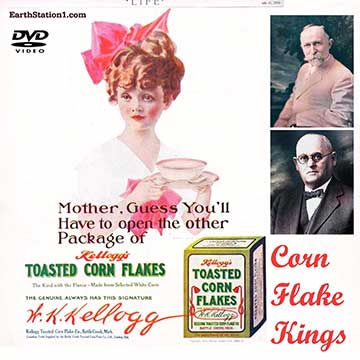
March 7: National Cereal Day: -- Get your bowl spoons ready! Since the end of the 19th century, cereal has become America's most popular breakfast food. Now, not only is cereal eaten for breakfast, but it has become a popular bedtime snack. Some people even enjoy a bowl for an evening meal. Bakers turn to cereal in their cake, cookie, and bar recipes. Ferdinand Schumacher, a German immigrant, began the cereal revolution in 1854 with a hand oats grinder in the back room of a small store in Akron, Ohio. His German Mills American Oatmeal Company was the nation's first commercial oatmeal manufacturer. In 1877, Schumacher adopted the Quaker symbol, the first registered trademark for a breakfast cereal. Granula, the first breakfast cereal, was invented in the United States in 1863 by James Caleb Jackson, operator of Our Home on the Hillside, which was later replaced by the Jackson Sanatorium in Dansville, New York. The cereal never became popular since it was inconvenient as the heavy bran nuggets needed soaking overnight before they were tender enough to eat. Do you remember mornings eating a bowl of cereal, reading the back of the box and trying to find the toy inside the box? The cereal industry rose from a combination of sincere religious beliefs and commercial interest in healthy foods. Dr. John Harvey Kellogg experimented with granola. He boiled some wheat, rolled it into thin films, and baked the resulting flakes in the oven; he acquired a patent in 1891. In 1895 he launched Cornflakes, which overnight captured a national market. In 1906, Dr. John Harvey Kellogg's brother, William K. Kellogg, after working for John, broke away, bought the corn flakes rights from his brother, and set up the Battle Creek Toasted Corn Flake Company. His signature on every package became the company trademark and insurance of quality. Charles W. Post introduced Grape-nuts in 1898 and soon followed with Post Toasties. So give a shout-out to your favorite cereal brand. Have a bowl for breakfast, lunch, and dinner. Share it as a snack. Create a delicious recipe from cereal and share your recipes. And use #NationalCerealDay to post on social media! On Sale @ 15% Off Discount Till Midnight PT! https://store.earthstation1.com/kebrcoflkibi.html
Today's
EarthStation1.com 15% Off Commemorative Memorial Title: Fibber
McGee And Molly Complete Radio Series MP3 DVD, Download, USB
Today, March 6, 2026
March 7: National Flapjack Day (National Pancake Day): -- Time for some piping hot flavor and goodness! National Flapjack Day honors the pancake, the sturdy, wholesome cakes we've been cooking up for generations! Recipes handed down from grandmother to son and mother to daughter continue to bring smiles to families all across the country. Flapjacks were a staple of pioneers pursuing new lives on the frontier. Packed with nutrients and energy, flapjacks provided the fuel they needed to withstand the often arduous trails. Stacked high, flapjacks remind us of mornings in grandma's kitchen when the coffee was fresh. We topped them with fresh blueberries and real maple syrup. Maybe today you add pecans or walnuts, thick-sliced bananas, and your favorite nut butter. Fresh whipped cream always makes flapjacks seem extra special, too. So mix up a batch of flapjacks and invite the family to add their favorite toppings. Share your most enjoyable memories and the best ways to serve them up, too! Take a photo of your flapjack meal. Do you add chocolate chips or peaches? How tall is your stack - three, four, maybe five high? Join the conversation by using #NationalFlapjackDay on social media! Kodiak Cakes founded National Flapjack Day in 2020 to celebrate the celebrate a healthier flapjack to fuel our consumers' daily frontier, whatever and wherever that may be. On Sale @ 15% Off Discount Till Midnight PT! https://store.earthstation1.com/fibber-mcgee-and-molly-mp3-dvd-complete-radio-serie3.html
Today's
EarthStation1.com 15% Off Commemorative Memorial Title: Mahatma
Mohandas Gandhi Documentaries DVD MP4 Download USB Drive
Today, March 6, 2026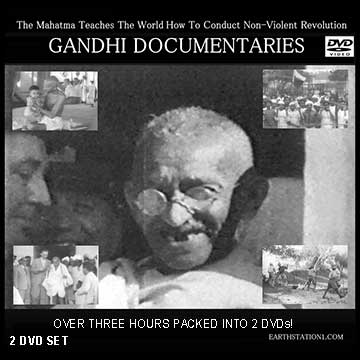
March 7: Plant Power Day: -- Get ready to experience and love all the healthy benefits of plant-based eating! Plant Power Day is celebrated to raise awareness about the benefits of sustainable eating and encourage everyone to embrace plant-based diets. Did you know Plant Power Day was launched by Alpro and BOSH!? Plant-based diets have different meanings depending on the individual. A plant-based diet may be entirely vegan - no animal-derived products - consisting mainly of plant foods, or is made up of whole plant foods that are minimally processed. While a plant-based diet has been an option for many people for ages, it's not until recently that it gained mainstream attention with people embracing it as a lifestyle. The history of plant-based diets is interwoven with veganism, which is itself derived from vegetarianism. The earliest evidence of vegetarianism appeared in 3300 to 1300 B.C. in the northern and western ancient Indus Valley Civilization. It was a lifestyle mainly practiced by Indian emperors and philosophers, including Chandragupta Maurya, Ashoka, Mahavira, and Acharya Kundakunda. Vegetarianism was also practiced in ancient Greece and Rome by prominent individuals such as Seneca the Younger, Ovid, Plutarch, and Empedocles. They argued this choice of lifestyle was due to health, the transmigration of souls, and animal welfare and justice. The Arab poet, all-Ma'arri, was one of the earliest known vegans. In the 19th century, vegetarianism became a widely accepted movement in Britain and the United States. Professionals that were self-identified vegetarians raised awareness of the benefits of the vegetarian lifestyle through their works. That includes the poet Percy Bysshe Shelley in his 1813 book, "A Vindication of Natural Diet," the physician William Lambe, and Sylvester Graham - he developed the meatless 'Graham diet' that was hugely popular in the 1830s in the United States. Several vegetarian communities and societies were established around this time. The United Kingdom Vegetarian Society, established in the 1840s, was one of those societies. Several members requested for a section of the Vegetarian Society's newsletter to be dedicated to non-dairy vegetarianism in 1994. When the Vegetarian Society refused the request, the secretary of the Leicester branch, Donald Watson, started a newsletter called "The Vegan News" in November of that year. That led to the establishment of the Vegan Society and the vegan movement - 'veganism'. The movement received a large following from individuals who eat mainly plant produce and desist animal exploitations. In 1980, T. Colin Campbell coined the term 'plant-based diet'. The term refers to a diet that is low fat, high fiber, and consists primarily of vegetables, focusing on health and not ethics. The term has since been used in various works to mean 'veganism', 'vegetarianism', and 'semi-vegetarianism'. In 2018, the European company Alpro, and vegan recipe website, BOSH!, established Plant Power Day to encourage people to eat a more vegetable-based diet and plant-based foods. On Sale @ 15% Off Discount Till Midnight PT! https://store.earthstation1.com/mahatma-mohandas-gandhi-nonviolent-revolution-biography-dvd.html
Today's
EarthStation1.com 15% Off Commemorative Memorial Title: Remember
When: It'll Never Fly w/ Dick Cavett Inventions DVD, MP4, USB
Today, March 6, 2026
March 7, 1876: Alexander Graham Bell Day: -- Great Inventions: Alexander Graham Bell is granted a patent for an invention he calls the "telephone". Born in Edinburgh, Scotland on March 3, 1847, Alexander Graham Bell, Scottish-American engineer, academic, scientist, inventor and innovator, went on to found the American Telephone and Telegraph Company (ATT) in 1885. Bell's father, grandfather, and brother had all been associated with work on elocution and speech and both his mother and wife were deaf, profoundly influencing Bell's life's work. His research on hearing and speech further led him to experiment with hearing devices which eventually culminated in Bell being awarded the first U.S. patent for the telephone in 1876. Bell developed an interest in the vibrating membrane as a method of electrically transmitting sounds. His very first sentence spoken on the newly invented telephone on March 10, 1876, was to his assistant, "Mister Watson, come here, I want you." Bell considered his invention an intrusion on his real work as a scientist and refused to have a telephone in his study. Many other inventions marked Bell's later life, including groundbreaking work in optical telecommunications, hydrofoils, and aeronautics. Although Bell was not one of the 33 founders of the National Geographic Society, he had a strong influence on the magazine while serving as the second president from January 7, 1898, until 1903. On Sale @ 15% Off Discount Till Midnight PT! https://store.earthstation1.com/remember-when-it39ll-never-fly-dvd-technology-history-dick-cave39.html
Today's
EarthStation1.com 15% Off Commemorative Memorial Title:
Revelation: The History Of Christianity DVD, Video Download, USB
Drive
Today, March 6, 2026
March 7, 321: Chronology: Calendars: The Week: The Days Of The Week: The Seven-Day Week: Days Of Rest: Dies Solis Invicti (Day Of The Invincible Sun, Sunday): -- Emperor Constantine I decrees that the Etruscan eight-day week that had been in use by Rome was to be replaced by the seven-day week, which originated with the Babylonians, for use throughout the Roman Empire, while also making Sunday a public holiday as "Dies Solis Invicti" (Day Of The Invincible Sun, or Sun-Day), the day of rest in the Empire; this change in the week later spread across Europe, then the rest of the world, and the observance of Sunday as a day of rest has remained in most of the Christian world ever since. He decreed: "On the venerable day of the Sun let the magistrates and people residing in cities rest, and let all workshops be closed. In the country however persons engaged in agriculture may freely and lawfully continue their pursuits because it often happens that another day is not suitable for grain-sowing or vine planting; lest by neglecting the proper moment for such operations the bounty of heaven should be lost." Constantine seems to have made this change himself and not through the papacy, since the papacy had not really yet come in to being. The papacy grew gradually out of the office of Bishop and for many years this was centered in Rome. With this decree, Constantine did not change the Sabbath; he merely made Sunday the official day of rest for the Roman Empire. His motivation was probably not born out of antisemitism but rather out of a desire to adopt what the Christians had practiced for nearly two and a half centuries. On Sale @ 15% Off Discount Till Midnight PT! https://store.earthstation1.com/revelation-the-history-of-christianity-documentary.html
Today's
EarthStation1.com 15% Off Commemorative Memorial Title: The
American Adventure: TV History Series 1607-1876 DVD MP4 USB Drive
Today, March 6, 2026
( #JCKaelin here: Meet #StephenHopkins, my grandfather some fourteen generations past! I am proud that he was one our nation's first longhair hippy activists, as well as his making that mojo work inside the system as well as out! :D ) ========= March 7, 1707: #BOTD: #HBD! Stephen Hopkins, governor of the Colony of Rhode Island and Providence Plantations, a Chief Justice of the Rhode Island Supreme Court, a signer of the Declaration Of Independence, great-grandfather some fourteen generations past of J. C. Kaelin, proprietor of the EarthStation1.com/MediaOutlet.com websites (d. July 13, 1785) is #born in Providence, Rhode Island. Hopkins was from a prominent Rhode Island family, the grandson of William Hopkins who served the colony for 40 years as Deputy, Assistant, Speaker of the House of Deputies, and Major. His great grandfather Thomas Hopkins was an original settler of Providence Plantation, sailing from England in 1635 with his cousin Benedict Arnold who became the first governor of the Rhode Island colony under the Royal Charter of 1663. As a child, Stephen Hopkins was a voracious reader, becoming a serious student of the sciences, mathematics, and literature. He became a surveyor and astronomer, and was involved in taking measurements during the 1769 transit of Venus across the sun. He began his public service at age 23 as a justice of the peace in the newly established town of Scituate, Rhode Island. He soon became a justice of the Inferior Court of Common Pleas, while also serving at times as the Speaker of the House of Deputies and President of the Scituate Town Council. While active in civic affairs, he also was part owner of an iron foundry and was a successful merchant who was portrayed in John Greenwood's 1750s satirical painting Sea Captains Carousing in Surinam. In May 1747, Hopkins was appointed as a justice of the Rhode Island Supreme Court, and he became the third Chief Justice of this body in 1751. In 1755, he was elected to his first term as governor of the colony, and he served in this capacity for nine out of the next 15 years. One of the most contentious political issues of his day was the use of paper money versus hard currency. His bitter political rival Samuel Ward championed hard currency, whereas Hopkins advocated the use of paper money. The rivalry between the two men became so heated that Hopkins sued Ward for 40,000 British Pounds, but he lost the case and had to pay costs. By the mid-1760s, the contention between the two men became a serious distraction to the government of the colony and, realizing this, they attempted to placate each other, initially without success. Ultimately, both agreed to not run for office in 1768, and Josias Lyndon was elected governor of the colony as a compromise candidate. In 1770, Hopkins once again became Chief Justice of the Rhode Island Supreme Court and, during this tenure, became a principal player in the colony's handling of the 1772 Gaspee Affair, when a group of irate Rhode Island citizens boarded a British revenue vessel and burned it to the waterline. In 1774, he was given an additional important responsibility as one of Rhode Island's two delegates to the First Continental Congress, his former rival Samuel Ward being the other. Hopkins had become well known in the thirteen colonies ten years earlier when he published a pamphlet entitled "The Rights of Colonies Examined" which was critical of British Parliament and its taxation policies. Hopkins signed the Declaration Of Independence in the summer of 1776 with worsening palsy in his hands. He signed it by holding his right hand with his left and saying, "My hand trembles, but my heart does not." He served in the Continental Congress until September 1776, when failing health forced him to resign. He was a strong backer of the College of the English Colony of Rhode Island and Providence Plantations (later named Brown University) and became the institution's first chancellor. He died in Providence in 1785 at the age of 78, and is buried in the North Burial Ground there. Hopkins has been called Rhode Island's greatest statesman. On Sale @ 15% Off Discount Till Midnight PT! https://store.earthstation1.com/the-american-adventure-series-us-1st-century-4-dv14.html
Today's
EarthStation1.com 15% Off Commemorative Memorial Title: The World:
A Television History Documentary Series DVD, Download, USB
Today, March 6, 2026
March 7, 1850: The United States: The History Of The United States: United States Expansionism: Origins Of The American Civil War: The Compromise Of 1850: The Seventh Of March Speech -- Senator Daniel Webster delivers his "Seventh Of March" speech endorsing the Compromise Of 1850 in order to prevent a possible civil war. He designed the speech to influence public opinion in favor of the compromise to preserve the Union; later he acknowledged that it was "probably the most important effort of my life." The Seventh Of March Speech is now considered a classic example of American political oratory, but at the time it deeply offended many in the North generally and in his state of Massachusetts specifically. As a result, Webster resigned as Senator. Despite this, Webster' support for the Compromise Of 1850, devised in part by Henry Clay, proved crucial to its passage. The Compromise Of 1850 was a package of five separate bills passed by the United States Congress in September 1850, which defused a four-year political confrontation between slave and free states on the status of territories acquired during the Mexican-American War (1846-1848). The compromise, drafted by Whig Senator Henry Clay of Kentucky and brokered by Clay and Democratic Senator Stephen Douglas of Illinois, reduced sectional conflict. Controversy arose over the Fugitive Slave provision. The Compromise was greeted with relief, but each side disapproved of some of its specific provisions: 1) Texas surrendered claim to New Mexico as well as its claims north of 36 deg. 30 min.. It retained the Texas Panhandle, and the federal government took over the state's public debt; 2) California was admitted as a free state, with its current boundaries; 3) The South prevented adoption of the Wilmot Proviso that would have outlawed slavery in the new territories, and the new Utah Territory and New Mexico Territory were allowed, under popular sovereignty, to decide whether to allow slavery in their borders. In practice, these lands were generally unsuited to plantation agriculture, and their settlers were uninterested in slavery; 4) The slave trade, but not slavery altogether, was banned in the District of Columbia; and 5) A more stringent Fugitive Slave Law was enacted. The Compromise became possible after the sudden death of President Zachary Taylor, who, although a slave owner, wanted to exclude slavery from the Southwest. Whig leader Henry Clay designed a compromise, which failed to pass in early 1850 because of opposition by both pro-slavery southern Democrats, led by John C. Calhoun, and anti-slavery northern Whigs. Upon Clay's instruction, Douglas then divided Clay's bill into several smaller pieces and narrowly won their passage, over the opposition of radicals on both sides. On Sale @ 15% Off Discount Till Midnight PT! https://store.earthstation1.com/the-world-a-television-history-4-dual-layer-dvds-all-26-sh426.html
Today's
EarthStation1.com 15% Off Commemorative Memorial Title:
Czechoslovakia: The Long Wait For Revolution DVD, Download, USB
Drive
Today, March 6, 2026
March 7, 1850: #BOTD: #HBD! Tomas Masaryk, sometimes anglicised as Thomas Masaryk, Austrian-Czech sociologist, philosopher and politician, 1st President of Czechoslovakia (d. September 14, 1937) is #born Tomas Garrigue Masaryk to a poor, working-class family in the predominantly Catholic city of Hodonin, Margraviate of Moravia, in Moravian Slovakia (in the present-day Czech Republic, then part of the Austrian Empire). The nearby Slovak village of Kopcany, the home of his father Jozef, also claims to be his birthplace. Masaryk grew up in the village of Cejkovice, in South Moravia, before moving to Brno to study. After trying to reform the Austro-Hungarian monarchy into a federal state with the help of the Allied Powers, he eventually succeeded in gaining Czechoslovak independence as a republic after World War I. He both founded and was the first President of Czechoslovakia and so is called the "President Liberator". He is the father of Jan Masaryk, Czech soldier, diplomat, politician, Czech Minister of Foreign Affairs from 1940 to 1948. Tomas Masaryk died in Lany, Czechoslovakia, aged 87. He was buried next to his wife in a plot at Lany cemetery, where later also the remains of his son Jan Masaryk and daughter Alice Masarykova were laid to rest. Masaryk was spared having to live to see the Munich Agreement and the Nazi occupation of his country, and was known as the Grand (Great) Old Man of Europe. On Sale @ 15% Off Discount Till Midnight PT! https://store.earthstation1.com/czechoslovakia-the-long-wait-for-spring-dvd-1988-cold1988.html
Today's
EarthStation1.com 15% Off Commemorative Memorial Title: SS:
1923-1945 History Of The Schutzstaffel Nazis DVD, MP4, USB Stick
Today, March 6, 2026
March 7, 1904: #BOTD: Reinhard Heydrich, high-ranking German Nazi official in manifold capacities, Schutzstaffel (SS) officer and war criminal during World War II, a main architect of the Holocaust, regarded by many historians as the darkest figure within the Nazi elite, and by Adolf Hitler as "the man with the iron heart" (d. June 4, 1942) is #born Reinhard Tristan Eugen Heydrichin Halle an der Saale to composer and opera singer Richard Bruno Heydrich and his wife, Elisabeth Anna Maria Amalia Heydrich (nee Krantz). Reinhard was an altar boy, attending evening prayers and Mass every week with his mother as part of the Catholic minority in Halle. Two of his forenames were musical references: "Reinhard" referred to the hero from his father's opera Amen, and "Tristan" stems from Richard Wagner's Tristan und Isolde. Heydrich's third name, "Eugen", was his late maternal grandfather's forename (Eugen Krantz had been the director of the Dresden Royal Conservatory). SS-Obergruppenfuehrer und General der Polizei (Senior Group Leader and General of Police) as well as chief of the Reich Main Security Office (including the Gestapo, Kripo, and SD). He was also Stellvertretender Reichsprotektor (Deputy/Acting Reich-Protector) of Bohemia and Moravia. Heydrich served as president of the International Criminal Police Commission (ICPC; later known as Interpol) and chaired the January 1942 Wannsee Conference, which formalised plans for the Final Solution to "the Jewish Question", the deportation and genocide of all Jews in German-occupied Europe. He was the founding head of the Sicherheitsdienst (SD), an intelligence organisation charged with seeking out and neutralising resistance to the Nazi Party via arrests, deportations, and murders. He helped organise Kristallnacht, a series of co-ordinated attacks against Jews throughout Nazi Germany and parts of Austria on 9-10 November 1938. The attacks, carried out by SA stormtroopers and civilians, presaged the Holocaust. Upon his arrival in Prague, Heydrich sought to eliminate opposition to the Nazi occupation by suppressing Czech culture and deporting and executing members of the Czech resistance. He was directly responsible for the Einsatzgruppen, the special task forces which travelled in the wake of the German armies and murdered over two million people, including 1.3 million Jews, by mass shooting and gassing. He was critically wounded in an ambush in Prague on 27 May 1942 by a British Special Operations Executive-trained team of Czech and Slovak soldiers who had been sent by the Czechoslovak government-in-exile to kill him in Operation Anthropoid. He died from his injuries a week later. Nazi intelligence falsely linked the assassins to the villages of Lidice and Lezaky. Both villages were razed; all men and boys over the age of 16 were shot, and all but a handful of the women and children were deported and killed in Nazi concentration camps. On Sale @ 15% Off Discount Till Midnight PT! https://store.earthstation1.com/ss-19231945-dvd-schutzstaffel-history-doc19231945.html
Today's
EarthStation1.com 15% Off Commemorative Memorial Title: The Road
To War: Years Between WWI & WWII TV Series DVD, Download, USB
Today, March 6, 2026
March 7, 1936: The Interwar Period (The Interbellum, Between The Wars): The Road To War: Nazi Germany (The German Reich, The Third Reich): The Remilitarisation Of The Rhineland (German: Rheinlandbesetzung): -- In violation of the Treaty Of Versailles, which defined the immediate dispensation of post-war Germany, and the Locarno Treaties, seven agreements which secured the post-war territorial dispensation of Germany, 3,000 German Wehrmacht troops, acting under orders from German Chancellor Adolf Hitler who used the Franco-Soviet Treaty of Mutual Assistance as a pretext, reoccupy the Rhineland, the area of Western Germany along the Rhine River, causing joyous celebrations across Germany. The Allied occupation of the Rhineland took place following the armistice that brought the fighting of World War I to a close on November 11, 1918. The occupying armies consisted of American, Belgian, British and French forces. Neither France nor Britain was prepared for a military response, and unwilling to risk war, decided against enforcing the treaties, and so did not act to prevent the German reoccupation. After 1939, commentators often said that a strong military move in 1936 might have ruined Hitler's aggressive plans. However, recent historiography agrees that both public and elite opinion in Britain and France strongly opposed a military intervention, and neither had an army prepared to move in. Under the 1919 Treaty Of Versailles, the German military was forbidden from all territory west of the Rhine or within 50 km east of it. The 1925 Locarno Treaties reaffirmed the permanently-demilitarized status of the Rhineland. In 1929, German Foreign Minister Gustav Stresemann negotiated the withdrawal of the Allied forces. The last soldiers left the Rhineland in June 1930. After the Nazis took power in 1933, Germany began working towards rearmament and the remilitarization of the Rhineland. The remilitarization changed the balance of power in Europe from France and its allies towards Germany by allowing Germany to pursue a policy of aggression in Western Europe that had been blocked by the demilitarized status of the Rhineland. The fact that Britain and France did not intervene made Hitler believe that neither country would get in the way of Nazi foreign policy. That made him decide to quicken the pace of German preparations for war and the domination of Europe. On March 14, 1936, during a speech in Munich, Hitler stated, "Neither threats nor warnings will prevent me from going my way. I follow the path assigned to me by Providence with the instinctive sureness of a sleepwalker". On Sale @ 15% Off Discount Till Midnight PT! https://store.earthstation1.com/the-road-to-war-dvd-set-all-8-tv-shows-4-dis84.html
Today's
EarthStation1.com 15% Off Commemorative Memorial Title: The Battle
Of Remagen Bridge Documentaries Set MP4 Download DVD
Today, March 6, 2026
March 7, 1945: The European Civil War: World War II: The Second European War (The European Theater Of World War II): The Western Allied Invasion Of Germany: Operation Lumberjack: The Battle Of Remagen: The Ludendorff Bridge (The Bridge At Remagen, The Remagen Bridge): -- Troops of the 1st U.S. Army seize the Ludendorff Bridge over the Rhine river at Remagen, one of two remaining bridges across the river Rhine in Germany during the closing weeks of World War II. Built in World War I to help deliver reinforcements and supplies to the German troops on the Western Front, it connected Remagen on the west bank and the village of Erpel on the eastern side between two hills flanking the river. Midway through Operation Lumberjack, a military operation with the goal of capturing the west bank of the Rhine River and seizing key German cities, the troops of the 1st U.S. Army approached Remagen and were surprised to find that the bridge was still standing. Its capture enabled the U.S. Army to establish a bridgehead on the eastern side of the Rhine. After the U.S. forces captured the bridge, German forces tried to destroy it multiple times until it collapsed on March 17, 1945, ten days after it was captured, killing 18 U.S. Army Engineers. While it stood, the bridge enabled the U.S. Army to deploy 25,000 troops, six Army divisions, with many tanks, artillery pieces and trucks, across the Rhine. It was never rebuilt. The towers on the west bank were converted into a museum and the towers on the east bank are a performing arts space. On Sale @ 15% Off Discount Till Midnight PT! https://store.earthstation1.com/the-battle-of-remagen-bridge-documentaries-set-mp4-download-dv4.html
Today's
EarthStation1.com 15% Off Commemorative Memorial Title: Korea: The
38th Parallel Korean War Richard Basehart MP4 Download DVD
Today, March 6, 2026
March 7, 1951: Korea: The History Of Korea: The Aftermath Of World War II: The Cold War: The Korean Conflict: The Korean War: The Battles Of Seoul: Operation Ripper (The Fourth Battle Of Seoul): -- Immediately following the largest artillery bombardment of the Korean War, United Nations troops led by the commander US Eighth Army, General Matthew Ridgway, begin an assault against Chinese forces to retake Seoul, which had changed hands three times since June of 1950; by April 4, Operation Ripper would succeed in retaking Seoul, changing hands for the fourth and final time. Operation Ripper was a United Nations military operation conceived by General Ridgway with the intention of destroying as much as possible of the Chinese communist People's Volunteer Army and North Korean military around Seoul and the towns of Hongchon, 50 miles east of Seoul, and Chunchon, 15 miles further south. The operation also aimed to bring UN troops to the 38th parallel. On Sale @ 15% Off Discount Till Midnight PT! https://store.earthstation1.com/korea-the-38th-parallel-korean-war-d38.html
Today's
EarthStation1.com 15% Off Commemorative Memorial Title: King: A
Filmed Record: Montgomery To Memphis DVD, Download, USB Drive
Today, March 6, 2026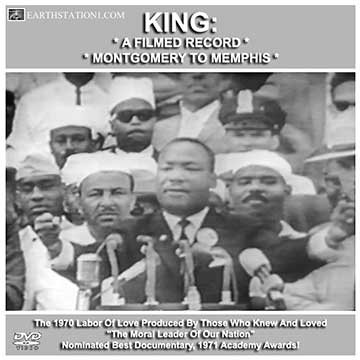
March 7, 1965: The American Civil Rights Movement: Anti-Black Racism In The United States: Segregation: Racial Segregation: Black Suffrage (Black Political Franchise, Black Franchise, Black Right To Vote, Black Active Suffrage): Civil Rights Protests: Civil Rights Protests In The United States: The Selma Voting Rights Campaign: The Selma To Montgomery Marches: The First Selma To Montgomery March (Bloody Sunday): -- In one of the most terrible, dramatic and historic events in the history of the Civil Rights Movement, 600 civil rights marchers, led by John Lewis of the Student Non Violent Coordinating Committee and Rev. Hosea Williams of the Southern Christian Leadership Conference, followed by Bob Mants of SNCC and Albert Turner of SCLC, are brutally attacked by state and local police on U.S. Highway 80 after they crossed the Edmund Pettus Bridge over the Alabama River in Selma, Alabama. Afterl the marchers crossed the Edmund Pettus Bridge, they encountered a wall of state troopers and county posse waiting for them on the other side. County sheriff Jim Clark had issued an order for all white men in Dallas County over the age of twenty-one to report to the courthouse that morning to be deputized. Commanding officer John Cloud told the demonstrators to disband at once and go home. Rev. Hosea Williams tried to speak to the officer, but Cloud curtly informed him there was nothing to discuss. Seconds later, the troopers began shoving the demonstrators, knocking many to the ground and beating them with nightsticks. Another detachment of troopers fired tear gas, and mounted troopers charged the crowd on horseback. Televised images of the brutal attack presented Americans and international audiences with horrifying images of marchers left bloodied and severely injured, and roused support for the Selma Voting Rights Campaign. Amelia Boynton, who had helped organize the march as well as marching in it, was beaten unconscious. A photograph of her lying on the road of the Edmund Pettus Bridge appeared on the front page of newspapers and news magazines around the world. Another marcher, Lynda Blackmon Lowery, age 14, was brutally beaten by a police officer during the march, and needed seven stitches for a cut above her right eye and 28 stitches on the back of her head. John Lewis suffered a skull fracture and bore scars on his head from the incident for the rest of his life. In all, 17 marchers were hospitalized and 50 treated for lesser injuries; the day soon became known as "Bloody Sunday" within the black community. Film of the brutal attack was televised on the ABC television network that evening, interrupting the television premiere of the film "Judgement At Nurmberg", a movie that challenged the master race theory of Nazi Germany in the same way the marchers were challenging the master race theory of American racism. In immediate response to the march, President Johnson issued an immediate statement "deploring the brutality with which a number of Negro citizens of Alabama were treated". He also promised to send a voting rights bill to Congress that week, although it took him until March 15. On Sale @ 15% Off Discount Till Midnight PT! https://store.earthstation1.com/king-a-filmed-record--montgomery-to-memphis-dvd.html
Today's
EarthStation1.com 15% Off Commemorative Memorial Title: Rock &
Roll An Unruly History 10 Part TV Series MP4 Video Download DVD
Today, March 6, 2026
March 7, 1985: Aesthetics: The Performing Arts: Music: Music History: Music Of The United States: Pop Music: The History Of Pop Music: Charity Records: Charity Singles (Charity Songs): We Are The World: -- We Are the World is released, a charity single originally recorded by the supergroup USA for Africa in 1985. It was written by Michael Jackson and Lionel Richie and produced by Quincy Jones and Michael Omartian for the album We Are the World. With sales in excess of 20 million copies, it is the eighth-bestselling physical single of all time. Soon after the UK-based group Band Aid released "Do They Know It's Christmas?" in December 1984, the musician and activist Harry Belafonte began to think about an American benefit single for African famine relief. He enlisted fundraiser Ken Kragen to help bring the vision to reality. The duo contacted several musicians, and enlisted Jackson and Richie to write the song; they completed the writing seven weeks after the release of "Do They Know It's Christmas?", and only one night before "We Are the World"'s first recording session, on January 21, 1985. The historic event brought together some of the era's best-known musicians. The song was released on March 7, 1985, as the first single from the album by Columbia Records. A worldwide commercial success, it topped music charts throughout the world and became the fastest-selling U.S. pop single in history. "We Are the World" received a Quadruple Platinum certification by the Recording Industry Association of America, becoming the first single to be certified multi-platinum. Awarded numerous honors-including three Grammy Awards, one American Music Award, and a People's Choice Award-the song was promoted with a critically received music video, a VHS, a special edition magazine, a simulcast, and several books, posters, and shirts. The promotion and merchandise helped "We Are the World" raise more than 63M USD (214M USD as of 2024) for humanitarian aid in Africa and the United States. On Sale @ 15% Off Discount Till Midnight PT! https://store.earthstation1.com/rock-amp-roll-an-unruly-history-10-part-tv-series-mp4-video-download-104.html
Today's
EarthStation1.com #OnThisDay Commemorative Memorial Title:
Battleline (1963) WWII TV Documentary Series DVD, Download, USB
Drive
Today, March 6, 2026 March 7: Jose Abad Santos Day: -- Jose
Abad Santos Day in the Philippines is observed on May 7 each year.
The day commemorates Jose Abad Santos, a former Chief Justice of
the Philippines during the second world war era. Santos
demonstrated uncommon patriotism and bravery for his home nation.
He rejected an invitation to flee the country and refused to
cooperate with the Japanese during his capture, which eventually
led to his execution. Santos is featured on the one thousand peso
bill alongside two other heroes for his martyrdom and resistance
against the Japanese occupation of World War II. On August 21,
2000, the Philippine Congress declared May 7 as a special
non-working holiday in the province of Pampanga to honor the
supreme martyr and hero, Jose Abad Santos. All schools, religious
institutions, civic organizations, provincial and municipal
communities, and individual citizens are required to observe this
day with the appropriate ceremonies. Santos was born on February
19, 1886. He was raised in Pampanga during the Philippine
Revolution against Spain. He was part of the first generation of
Filipinos sent to study at American universities. After graduating
with a law degree, Santos took up the position of legal counsel
for the Philippine National Bank and the Manila Railroad Company.
He continued to rapidly rise through the ranks. On December 24,
1941, Santos was appointed the Chief Justice of the Supreme Court
of the Philippines. In March 1942, Santos displayed steadfast
patriotism when he was invited by President Manuel Quezon to leave
with him to the United States as a result of a rapidly advancing
Japanese invasion. However, Santos declined, preferring to remain
in the Philippines. Before he departed for the United States on
March 17, 1942, Quezon appointed Santos as the Acting President
and Commander-in-Chief of the Armed Forces of the Philippines.
Santos and his son were captured by the Japanese in Cebu on April
11, 1942. In his capture, Abad further demonstrated personal
integrity and loyalty to his nation by refusing to cooperate with
the Japanese. He showed bravery and self-sacrifice even when
threatened with death. On May 2, 1942, Santos was executed by the
Japanese forces after being held in confinement for two days.
https://store.earthstation1.com/battleline-wwii-tv-documentary-series-5-dual-layer-dvd5.html
March 7: Jose Abad Santos Day: -- Jose
Abad Santos Day in the Philippines is observed on May 7 each year.
The day commemorates Jose Abad Santos, a former Chief Justice of
the Philippines during the second world war era. Santos
demonstrated uncommon patriotism and bravery for his home nation.
He rejected an invitation to flee the country and refused to
cooperate with the Japanese during his capture, which eventually
led to his execution. Santos is featured on the one thousand peso
bill alongside two other heroes for his martyrdom and resistance
against the Japanese occupation of World War II. On August 21,
2000, the Philippine Congress declared May 7 as a special
non-working holiday in the province of Pampanga to honor the
supreme martyr and hero, Jose Abad Santos. All schools, religious
institutions, civic organizations, provincial and municipal
communities, and individual citizens are required to observe this
day with the appropriate ceremonies. Santos was born on February
19, 1886. He was raised in Pampanga during the Philippine
Revolution against Spain. He was part of the first generation of
Filipinos sent to study at American universities. After graduating
with a law degree, Santos took up the position of legal counsel
for the Philippine National Bank and the Manila Railroad Company.
He continued to rapidly rise through the ranks. On December 24,
1941, Santos was appointed the Chief Justice of the Supreme Court
of the Philippines. In March 1942, Santos displayed steadfast
patriotism when he was invited by President Manuel Quezon to leave
with him to the United States as a result of a rapidly advancing
Japanese invasion. However, Santos declined, preferring to remain
in the Philippines. Before he departed for the United States on
March 17, 1942, Quezon appointed Santos as the Acting President
and Commander-in-Chief of the Armed Forces of the Philippines.
Santos and his son were captured by the Japanese in Cebu on April
11, 1942. In his capture, Abad further demonstrated personal
integrity and loyalty to his nation by refusing to cooperate with
the Japanese. He showed bravery and self-sacrifice even when
threatened with death. On May 2, 1942, Santos was executed by the
Japanese forces after being held in confinement for two days.
https://store.earthstation1.com/battleline-wwii-tv-documentary-series-5-dual-layer-dvd5.html
Today's
EarthStation1.com #OnThisDay Commemorative Memorial Title: Aliens
Invade Hollywood! 20th Century SF Films MP4 Video Download DVD
Today, March 6, 2026March 7, 1999: #DOTD: #RIP: Stanley
Kubrick, American director, producer, screenwriter, filmmaker and
photographer, a major figure of the post-war film industry, widely
regarded as one of the greatest and most influential filmmakers in
the history of cinema (b. July 26, 1928) unexpectedly #dies of a
heart attack in his sleep at his home, Childwickbury Manor, in
Hertfordshire, England, aged 70, six days after screening a final
cut of Eyes Wide Shut for his family and the film's stars. His
funeral was held five days later at his home, Childwickbury Manor,
in Hertfordshire, England with only close friends and family in
attendance, totaling about 100 people. The media were kept a mile
away outside the entrance gate. Alexander Walker, who attended the
funeral, described it as a "family farewell, ... almost like
an English picnic" with cellists, clarinetists, and singers
providing music from many of Kubrick's favorite classical
compositions. Kaddish, the Jewish prayer typically said by
mourners and in other contexts, was recited. A few of his
obituaries mentioned his Jewish background. Among those who gave
eulogies were his brother-in-law Jan Harlan, Terry Semel, Steven
Spielberg, Nicole Kidman, and Tom Cruise. He was buried next to
his favorite tree on the estate. In her book dedicated to him, his
wife Christiane included one of his favorite quotations of Oscar
Wilde: "The tragedy of old age is not that one is old but
that one is young." It has been alleged that he was murdered
after exposing too much about secret organisations such as that
depicted in the film. According to Roger Avery, the co-writer of
Pulp Fiction who also has an original script of Eyes Wide Shut,
the film was centered around an elite pedophile ring and the final
scene was meant to depict Tom Cruise and Nicole Kidman's
characters sending their child to the ring. During the final
scene, you can see them sort of nudge their daughter towards two
older men, let her walk away, and take their eyes off of her. It
was suggested that he died of an induced heart attack over this
ending. Stanley Kubrick was born to a Jewish family in the
Lying-In Hospital in Manhattan, New York City. His films were
nearly all adaptations of novels or short stories, spanning a
number of genres and gaining recognition for their intense
attention to detail, innovative cinematography, extensive set
design, and dark humor. Kubrick taught himself film producing and
directing after graduating from high school. After working as a
photographer for Look magazine in the late 1940s and early 1950s,
he began making low-budget short films and made his first major
Hollywood film, The Killing, for United Artists in 1956. This was
followed by two collaborations with Kirk Douglas: the anti-war
film Paths of Glory (1957) and the historical epic film Spartacus
(1960). In 1961, Kubrick left the United States and settled in
England. In 1978, he made his home at Childwickbury Manor with his
wife Christiane, and it became his workplace where he centralized
the writing, research, editing, and management of his productions.
This permitted him almost complete artistic control over his
films, with the rare advantage of financial support from major
Hollywood studios. His first productions in England were two films
with Peter Sellers: the comedy-drama Lolita (1962) and the Cold
War satire Dr. Strangelove (1964). A perfectionist who assumed
direct control over most aspects of his filmmaking, Kubrick
cultivated an expertise in writing, editing, color grading,
promotion, and exhibition. He was famous for the painstaking care
taken in researching his films and staging scenes. He frequently
asked for several dozen retakes of the same shot in a film, often
confusing and frustrating his actors. Despite the notoriety this
provoked, many of Kubrick's films broke new cinematic ground and
are now considered landmarks. The scientific realism and
innovative special effects in his science fiction epic 2001: A
Space Odyssey (1968) were a first in cinema history; the film
earned him his only Academy Award (for Best Visual Effects) and is
regarded as one of the greatest films ever made. While many of
Kubrick's films were controversial and initially received mixed
reviews upon release -- particularly the brutal A Clockwork Orange
(1971), which Kubrick withdrew from circulation in the UK
following a media frenzy -- most were nominated for Academy
Awards, Golden Globes, or BAFTA Awards, and underwent critical
re-evaluations. For the 18th-century period film Barry Lyndon
(1975), Kubrick obtained lenses developed by Carl Zeiss for NASA
to film scenes by candlelight. With the horror film The Shining
(1980), he became one of the first directors to make use of a
Steadicam for stabilized and fluid tracking shots, a technology
vital to his Vietnam War film Full Metal Jacket (1987).
https://store.earthstation1.com/aliens-invade-hollywood-20th-century-sf-films-mp4-video-download-dvd.html
Today's
EarthStation1.com #OnThisDay Commemorative Memorial Title: WWII
Films: African Americans At War Films Set DVD, MP4, USB Drive
Today, March 6, 2026March 7, 1942: The European Civil War:
World War II: The Second European War (The European Theater Of
World War II): Air Warfare Of World War II: The Tuskegee Airmen: :
-- The Tuskegee Institute (now Tuskegee University) graduates its
first class of what was to become known as The Tuskegee Airmen, a
distinguished group of African American fighter and bomber pilots
and airmen who fought in World War II in the 332d Fighter Group
and the 477th Bombardment Group (Medium) of the United States Army
Air Forces (USAAF). This class of particularly distinguished
pilots, who trained at The Tuskegee Army Air Field, Moton Field
(now The Tuskegee Airmen National Historic Site at Moton Field
Municipal Airport) in Tuskegee, Alabama are officially known as
"Graduating Cadet Class - Single Engine Section - SE-42-C".
These five men were the first of some 1007 documented cadet pilot
graduates: 1) 2nd Lt Lemuel R. Custis (June 4, 1915 - February 24,
2005), who became Connecticut's first African American chief of
sales tax, retiring as the Tax Department's Chief Examiner after a
30-year caree; 2) Captain Benjamin O. Davis Jr. (December 18, 1912
- July 4, 2002), commander of the Tuskegee Airmen 99th Fighter
Squadron and the 332nd Fighter Group, first African American
general in the U.S. Air Force, who ultimately became a four-star
general; 3) 2nd Lt Charles DeBow (February 13, 1918 - April 4,
1986), combat fighter pilot and commanding officer of the 332nd
Fighter Group's 301st Fighter Squadron, associate English lecturer
at Indiana University-Purdue University Indianapolis (IUPUI); 4)
2nd Lt George S. "Spanky" Roberts (September 24, 1918 -
March 8, 1984), commander of the 332nd Fighter Group, who at
Langley Air Force Base in 1950 became the first African American
U.S. Air Force officer to command a racially-integrated unit, who
became a credit officer, training officer, and personal banking
officer at Wells Fargo in Sacramento, California; and 5) 2nd Lt
Mac Ross (June 12, 1912 - July 10, 1944), commander of the 100th
Fighter Squadron and Group Operations Officer for the 332nd
Fighter Group. The name Tuskegee Airmen also applies to the
navigators, bombardiers, mechanics, instructors, crew chiefs,
nurses, cooks and other support personnel who did not recieve
pilot training.
https://store.earthstation1.com/wwii-films-africanamericans-at-war-dvd.html
Today's
EarthStation1.com #OnThisDay Commemorative Memorial Title:
Alternative Sgt. Pepper's Lonely Hearts Club Band MP3 CD Download
USB
Today, March 6, 2026March 7, 1952: #DOTD: #RIP: Paramahansa
Yogananda, Indian-American monk, yogi, guru and philosopher who
introduced millions to the teachings of meditation and Kriya Yoga
through his organization Self-Realization Fellowship (SRF) /
Yogoda Satsanga Society (YSS) of India, and who lived his last 32
years in America (b. January 5, 1893) #dies of heart failure at
the Biltmore Hotel, Los Angeles, California, aged 59. Yogananda's
remains are interred at the Forest Lawn Memorial Park in the Great
Mausoleum (normally closed off to visitors but Yogananda's tomb is
accessible) in Glendale, California. In the days leading up to his
death, Yogananda began hinting to his disciples that it was time
for him to leave the world. On March 7, 1952, he attended a dinner
for the visiting Indian Ambassador to the US, Binay Ranjan Sen,
and his wife at the Biltmore Hotel in Los Angeles. At the
conclusion of the banquet, Yogananda spoke of India and America,
their contributions to world peace and human progress, and their
future co-operation, expressing his hope for a "United World"
that would combine the best qualities of "efficient America"
and "spiritual India." According to an eyewitness - Daya
Mata, a direct disciple of Yogananda, who was head of the
Self-Realization Fellowship from 1955 to 2010 - as Yogananda ended
his speech, he read from his poem My India, concluding with the
words "Where Ganges, woods, Himalayan caves, and men dream
God - I am hallowed; my body touched that sod." "As he
uttered these words, he lifted his eyes to the Kutastha center
(the Ajna Chakra or "spiritual eye"), and his body
slumped to the floor." His followers said that he entered
mahasamadhi; the cause of death was heart failure. His funeral
service, with hundreds attending, was held at the SRF headquarters
atop Mt. Washington in Los Angeles. Rajarsi Janakananda, who
Yogananda chose to succeed him as the new president of the
Self-Realization Fellowship, "performed a sacred ritual
releasing the body to God." For three weeks afterwards,
Yogananda's body did not decay. Those working with its mortuation
process called it "the most extraordinary case in our
experience..this state of perfect preservation of a body is, so
far as we know from mortuary annals, an unparalleled one...a
phenomal state of immutability...no odor of decay emanated from
his body at any time...for these reasons we state again that the
case of Paramhansa Yogananda is unique in our experience."
Paramahansa Yogananda was born Mukunda Lal Ghosh to a Hindu family
of Bengali Kayastha, a Bengali Hindu who is a member of the
Kayastha community. The historical caste occupation of Kayasthas
throughout India has been that of scribes and administrators; the
Kayasthas in Bengal also became the region's surrogate Kshatriya
or warrior class and, along with Brahmins are regarded as the
highest of Hindu castes that comprise the upper layer of Hindu
society As a chief disciple of the Bengali yoga guru Swami Sri
Yukteswar Giri, Yogananda was sent by his lineage to spread the
teachings of yoga to the West, to prove the unity between Eastern
and Western religions and to preach a balance between Western
material growth and Indian spirituality. His long-standing
influence in the American yoga movement, and especially the yoga
culture of Los Angeles, led him to be considered by yoga experts
as the "Father of Yoga in the West". Yogananda was the
first major Indian teacher to settle in America, and the first
prominent Indian to be hosted in the White House (by President
Calvin Coolidge in 1927); his early acclaim led to him being
dubbed "the 20th century's first superstar guru," by the
Los Angeles Times. Arriving in Boston in 1920, he embarked on a
successful transcontinental speaking tour before settling in Los
Angeles in 1925. For the next two and a half decades, he gained
local fame as well as expanded his influence worldwide: he created
a monastic order and trained disciples, went on teaching-tours,
bought properties for his organization in various California
locales, and initiated thousands into Kriya Yoga. By 1952, SRF had
over 100 centers in both India and the US; today, they have groups
in nearly every major American city. His "plain living and
high thinking" principles attracted people from all
backgrounds among his followers. He published his book
Autobiography of a Yogi in 1946 to critical and commercial
acclaim; since its first publishing, it has sold over four million
copies, with HarperSan Francisco listing it as one of the "100
best spiritual books of the 20th Century". Former Apple CEO
Steve Jobs had ordered 500 copies of the book for his own
memorial, for each guest to be given a copy. The book has been
regularly reprinted and is known as "the book that changed
the lives of millions." A 2014 documentary, Awake: The Life
of Yogananda, won multiple awards at film festivals around the
world. His continued legacy around the world, remaining a leading
figure in Western spirituality to the current day, led authors
such as Philip Goldberg to consider him "the best known and
most beloved of all Indian spiritual teachers who have come to the
West....through the strength of his character and his skillful
transmission of perennial wisdom, he showed the way for millions
to transcend barriers to the liberation of the soul."
https://store.earthstation1.com/alternative-sgt-pepper39s-lonely-hearts-club-band-mp3-cd-download-393.html
Today's
EarthStation1.com #OnThisDay Commemorative Memorial Title: Eyes On
The Prize II: America At The Racial Crossroads DVD MP4 USB
Today, March 6, 2026March 7, 1979: Music History: Music Of
The United States: African-American Music: -- The state of Georgia
honors African American pianist and composer Ray Charles with a
formal apology for an incident affecting his performance in the
state in 1961. At that time, Charles, born in Albany, GA, had
refused to perform in front of a segregated all-white audience at
a dance in Augusta, Georgia. Charles canceled his appearance after
discovering that the event was restricted to white patrons, with
Blacks relegated to the balcony of the Music Hall. He left Augusta
immediately after letting the public know his objection to the
segregated seating of the audience. The promoter sued Charles for
canceling, a Fulton County court in Atlanta the following year
fined Charles 757USD for the cancelation. Some eighteen years
later, Charles was not only vindicated for this by receiving a
formal apology from the state of Georgia in 1979, his version of
the song "Georgia On My Mind" was made the official
state song of Georgia later year, as well as became one of the
first of the Georgia State Music Hall of Fame honorees to be
recognized as a musician born in the state.
https://store.earthstation1.com/eyes-on-the-prize-ii-dvd-set-4-discs-complete-2nd-seri42.html
Today's
EarthStation1.com #OnThisDay Commemorative Memorial Title: A
Moment In Time (1976) Film History DVD, Video Download, USB Drive
Today, March 6, 2026March 7, 2006: #DOTD: #RIP: Gordon Parks,
African American photographer, film director, pianist, songwriter,
composer, poet, writer and painter (b. November 30, 1912) #dies of
complications from high blood pressure and prostate cancer at his
home in Manhattan at the age of 93. Born Gordon Roger Alexander
Buchanan Parks in Fort Scott, Kansas, he became prominent in U.S.
documentary photojournalism in the 1940s through 1970s,
particularly in issues of civil rights, poverty and African
Americans, and in glamour photography. Parks was the first African
American to produce and direct major motion pictures, developing
films relating the experience of slaves and struggling black
Americans, and creating the "blaxploitation" genre. He
is best remembered for his iconic photos of poor Americans taken
during the 1940s for a federal government project of the Farm
Security Administration, for his photographic essays for Life
magazine, and as the director of the 1971 film Shaft.
https://store.earthstation1.com/a-moment-in-time-dvd-film-history-narrated-by-gordon-parks.html
Today's
EarthStation1.com #OnThisDay Commemorative Memorial Title:
Vaudeville Vanities TV Show & Movie Film Set DVD, Download,
USB Drive
Today, March 6, 2026March 7, 1975: #DOTD: #RIP: Ben Blue,
Canadian-American vaudeville actor and comedian (b. December 9,
1901) #dies in Hollywood, California at the age of 73. He was
interred in the Hillside Memorial Park Cemetery in Culver City,
California. After his death, his career papers covering 1935 to
1955 were deposited in the Special Collections at the University
of California, Los Angeles Library. He was born Benjamin Bernstein
in Montreal, Quebec on September 12, 1901 into the Jewish family
of David Asher Bernstein and Sadie Goldberg. Blue emigrated to
Baltimore, Maryland at the age of nine, where he won a contest for
the best impersonation of Charlie Chaplin. At the age of fifteen
he was in a touring company and later became a stage manager and
assistant general manager. He became a dance instructor and
nightclub proprietor. In the 1920s Blue joined a popular
orchestra, Jack White and His Montrealers. The entire band
emphasized comedy, and would continually interact with the
joke-cracking maestro. Blue, the drummer, would sometimes deliver
corny jokes while wearing a ridiculously false beard. The band
emigrated to the United States, and appeared in two early sound
musicals - the Vitaphone short subject Jack White and His
Montrealers and Universal's feature-length 2-strip Technicolor
revue King of Jazz (1930). In 1930, Blue toured with the "Earl
Carroll Vanities". Blue left the band to establish himself as
a solo comedian, portraying a bald-headed dumb-bell with a goofy
expression. Producer Hal Roach featured him in his "Taxi
Boys" comedy shorts, but Blue's dopey character was an
acquired taste and he was soon replaced by other comedians. Later
in the 1930s he worked at Paramount Pictures, notably in The Big
Broadcast of 1938, and later at Metro-Goldwyn-Mayer, in films such
as Easy to Wed. He was divorced by his first wife in 1937. He was
ordered to pay 600 USD (approximately 11K USD in 2020) monthly
alimony. The judge told him: "You are no exception to the
rule that theatrical careers do not last long, and yours already
has been a long one." In 1950, he had his own short-lived TV
series, The Ben Blue Show, and was also a regular on The Frank
Sinatra Show. Blue was a guest star on the summer replacement
television show Saturday Night Revue in 1954. In 1951, Blue began
concentrating on managing and appearing in nightclubs in
Hollywood, California and San Francisco. He once appeared in a
Reno, Nevada nightclub called the Dollhouse where he lost 25K USD
to its owner, Bill Welch. Blue and Maxie Rosenbloom owned and
performed in Hollywood's top nightclub in the 1940s called
"Slapsie Maxie's." Again, in the 1960s he opened a
nightclub in Santa Monica, California, called "Ben Blue's".
It quickly became the "in" place and night after night
was packed with top celebrities. Ben closed the club three years
later because of health problems. Blue made the cover of TV
Guide's June 11, 1954 Special Issue along with Alan Young,
headlining an edition featuring that season's summer replacement
shows. He also made appearances in TV shows such as The Jack Benny
Program and The Milton Berle Show. In 1958 he had major surgery.
In 1958 he starred in a television pilot called Ben Blue's
Brothers, in which he played four different parts. The show did
not get picked up by a network, but the pilot was seen in 1965. In
1964 he was indicted by a federal grand jury on six counts of tax
evasion for the non-payment of more than 39K USD (approximately
321K USD in 2020) in income taxes from the nightclub he operated,
the Merry-Go-Round, in Santa Monica, California. The case was
contested for five years, before he pled no contest to a single
count of evading corporate tax. He was fined 1K USD, with the
payment suspended. He also had a recurring role in Jerry Van
Dyke's television series Accidental Family in 1967. His film roles
included many cameo appearances. In It's a Mad, Mad, Mad, Mad
World (1963), his role was the pilot of the Standard J-1 biplane
that flew Sid Caesar and Edie Adams, and he played Luther Grilk,
the town drunk, in The Russians Are Coming, the Russians Are
Coming (1966). His other film appearances included small roles in
The Busy Body (1967), A Guide for the Married Man (1967) and Where
Were You When the Lights Went Out? (1968). He made one of his last
television appearances in Land of the Giants in 1969. He was also
seen the following year in the Dora Hall vanity syndicated
television special, "Once Upon a Tour".
https://store.earthstation1.com/vaudeville-tv-vanities-olsen-amp-johnson-ben-blue-dual-layer-dvd.html
Today's
EarthStation1.com #OnThisDay Commemorative Memorial Title: Rowan &
Martin's Laugh-In MegaSet 2 Albums 2 Blooper Sets MP3 MP4 DVD
Today, March 6, 2026March 7, 1926: #BOTD: #HBD! Alan Sues,
American soldier, actor and comedian, widely known for his roles
on the 1968-1973 television series Rowan & Martin's Laugh-In
(d. December 1, 2011) is #born Alan Grigsby Sues in Ross,
California. Sues's on-screen persona was campy and outrageous.
Typical of his humor was a skit that found him following a pair of
whiskey-drinking cowboys to a Wild West bar and requesting a
frozen daiquiri. His recurring characters on the program included
"Big Al the Sportscaster", "Uncle Al the Kiddies'
Pal", and "Jo Anne Worley", after Worley left the
show. Sues was born to Alice (nee Murray) and Melvyn Sues, who
raised racehorses, requiring the family to move frequently. He
served in the U.S. Army in Europe during World War II. Sues used
his GI Bill benefits to pay for acting lessons at the Pasadena
Playhouse, where he performed, later making his Broadway debut in
the stage play Tea and Sympathy, directed by Elia Kazan, which had
a successful run in New York City beginning in 1953. During this
period, he met and married Phyllis Gehrig, a dancer and actress,
subsequently starting a vaudevillian nightclub act in Manhattan -
with which they toured North America before divorcing in 1958.
After touring the country with his wife, he got more work in
stand-up comedy (at Reuben Bleu and Blue Angel, both clubs in
Manhattan), worked with Julius Monk, and joined an improv/sketch
group with The Mad Show, which led to his being cast in Laugh-In.
Outside of Laugh-In, he appeared in the classic Twilight Zone
episode "The Masks", in a non-comedic role. He also had
supporting roles in the films Move Over, Darling (1963) and The
Americanization of Emily (1964). After Laugh-In, Sues portrayed
Professor Moriarty onstage in Sherlock Holmes (opposite John Wood,
and later Leonard Nimoy), which, according to Alan, was "one
of my favorite roles, because it's so against type, and I loved
the makeup". The makeup for Moriarty was used in several
books about makeup as an example of shadowing and technique. Sues
appeared in television commercials for Peter Pan Peanut Butter
during the 1970s, as a tongue-in-cheek, klutzy Peter Pan. He
toured with Singin' in the Rain, playing the Elocution Instructor.
He also appeared in several movies, and provided voiceovers
including Oh! Heavenly Dog and Rudolph and Frosty's Christmas in
July. During the 1970s, Sues appeared as a celebrity guest on some
popular game shows of the era, including The Movie Game, Celebrity
Sweepstakes, The Cross-Wits and Liar's Club. Sues appeared in the
short films Lord of the Road (1999) and Artificially Speaking
(2009), the latter making its premiere at the 2009 Dances With
Films festival in Los Angeles. In 2008, fifty years after their
divorce, Sues and his former wife, Phyllis, conducted a lengthy
interview at his home for her website. Sues died on December 1,
2011 at Cedars-Sinai Medical Center, Los Angeles, where he was
taken after suffering an apparent heart attack while watching
television with his beloved dog, Doris, according to his partner
and accountant, Michael Michaud.
https://store.earthstation1.com/rowan-and-martin-discount-set-2-albums-2-blooper-reel-sets-mp3-mp4-dvd.html
Today's
EarthStation1.com #OnThisDay Commemorative Memorial Title: The
Story Of Civilization: Will & Ariel Durant DVD, MP3 Download,
USB
Today, March 6, 2026March 7, 161: #DOTD: #RIP: Antoninus
Pius, Roman emperor from 138 to 161 (b. September 19, 86) #dies
and is succeeded by his adoptive sons Marcus Aurelius and Lucius
Commodus (who changed his name to Lucius Verus). Two days before
his death, his biographyin The Historia Augusta reports, Antoninus
was at his ancestral estate at Lorium, in Etruria, about twelve
miles (19 km) from Rome. He ate Alpine Gruyere cheese at dinner
quite greedily. In the night he vomited; he had a fever the next
day. The day after that, 7 March 161, he summoned the imperial
council, and passed the state and his daughter to Marcus. The
emperor gave the keynote to his life in the last word that he
uttered: when the tribune of the night-watch came to ask the
password, he responded, "aequanimitas" (equanimity). He
then turned over, as if going to sleep, and died. His death closed
out the longest reign since Augustus (surpassing Tiberius by a
couple of months). His record for the second-longest reign would
be unbeaten for 168 years, until 329 when it was surpassed by
Constantine The Great. Antoninus Pius' funeral ceremonies were, in
the words of the biographer, "elaborate". If his funeral
followed the pattern of past funerals, his body would have been
incinerated on a pyre at the Campus Martius, while his spirit
would rise to the gods' home in the heavens. However, it seems
that this was not the case: according to his Historia Augusta
biography (which seems to reproduce an earlier, detailed report)
Antoninus' body (and not his ashes) was buried in Hadrian's
mausoleum. After a seven-day interval (justitium), Marcus and
Lucius nominated their father for deification. In contrast to
their behavior during Antoninus' campaign to deify Hadrian, the
senate did not oppose the emperors' wishes. A flamen, or cultic
priest, was appointed to minister the cult of the deified
Antoninus, now Divus Antoninus. A column was dedicated to
Antoninus on the Campus Martius, and the temple he had built in
the Forum in 141 to his deified wife Faustina was rededicated to
the deified Faustina and the deified Antoninus. It survives as the
church of San Lorenzo in Miranda. Antoninus Pius (Latin: Antoninus
Pius) 19 September 86 - 7 March 161) was He was one of the Five
Good Emperors in the Nerva-Antonine dynasty. Born into a
senatorial family, Antoninus held various offices during the reign
of emperor Hadrian, who adopted him as his son and successor
shortly before his death. Antoninus acquired the cognomen Pius
after his accession to the throne, either because he compelled the
Senate to deify his adoptive father, or because he had saved
senators sentenced to death by Hadrian in his later years. His
reign is notable for the peaceful state of the Empire, with no
major revolts or military incursions during this time, and for his
governing without ever leaving Italy. A successful military
campaign in southern Scotland early in his reign resulted in the
construction of the Antonine Wall. Antoninus was an effective
administrator, leaving his successors a large surplus in the
treasury, expanding free access to drinking water throughout the
Empire, encouraging legal conformity, and facilitating the
enfranchisement of freed slaves.
https://store.earthstation1.com/story-of-civilization-will-amp-ariel-durant-mp3-dvd-11-audiobo311.html
Today's
EarthStation1.com #OnThisDay Commemorative Memorial Title: The
Steve Allen TV Shows MegaSet DVD, Video Download, USB Flash Drive
Today, March 6, 2026March 7, 2024: #DOTD: #RIP: Steve
Lawrence, American singer, comedian, and actor, best known as a
member of the pop duo Steve and Eydie with his wife Eydie Gorme,
and for his performance as Maury Sline, the manager and friend of
the main characters in the 1980 film The Blues Brothers (b. July
8, 1935) #dies from complications due to Alzheimer's disease in
Los Angeles, on March 7, 2024, at the age of 88. He is buried at
Hillside Memorial Park cemetery in Culver City, Los Angeles,
California, alongside his beloved wife Eydie. Steve Lawrence was
born Sidney Liebowitz in Brooklyn, New York to Jewish parents Max,
cantor at the Brooklyn synagogue Beth Sholom Tomchei Harav, Helen,
a homemaker. He attended Thomas Jefferson High School, and while
there, Lawrence skipped school to spend time at the Brill Building
in the hopes of being employed as a singer. Steve and Eydie first
appeared together as regulars on Tonight Starring Steve Allen in
1954 and continued performing as a duo until Gorme's retirement in
2009. In June 2019, following public speculation about his health,
Lawrence announced that he was in the early stages of Alzheimer's
disease and that treatment to slow its progression had so far been
successful.
https://store.earthstation1.com/complete-steve-allen-tv-shows-4-dual-layer-dvd-megase4.html
Today's
EarthStation1.com #OnThisDay Commemorative Memorial Title: The
Monarchy: British Royal Family History TV Series DVD MP4 USB Drive
Today, March 6, 2026March 7, 1930: #BOTD: #HBD! Antony
Armstrong-Jones, commonly known as Lord Snowdon, 1st Earl of
Snowdon GCVO FRSA RDI, English photographer and filmmaker, one
time husband of Princess Margaret and brother-in-law of Queen
Elizabeth II, best known for his portraits of world notables, many
of them published in Vogue, Vanity Fair, and other major venues,
including more than 100 of his photographs in the permanent
collections of the National Portrait Gallery (d. January 13, 2017)
is #born Antony Charles Robert Armstrong-Jones at Eaton Terrace in
Belgravia, central London, England as the only son of the marriage
of the Welsh barrister Ronald Armstrong-Jones (1899-1966) and his
first wife, Anne Messel (later Countess of Rosse; 1902-1992).
Antony Armstrong-Jones died peacefully at his home in Kensington
of natural causes aged 86. His funeral took place on January 20 at
St Baglan's Church in the remote village of Llanfaglan, a parish
in Gwynedd, north-west Wales near Caernarfon. He is buried in the
family plot in the churchyard.
https://store.earthstation1.com/the-monarchy-3-part-british-royal-family-tv-series-dvd-mp4-u34.html
Today's
EarthStation1.com #OnThisDay Commemorative Memorial Title: Rock!
UK: British Invasion Rock Documentary DVD, Download, Flash Drive
Today, March 6, 2026March 7, 2013: #DOTD: #RIP: Peter Banks,
English guitarist, vocalist, songwriter, producer and pioneer of
progressive rock music, best known as the original guitarist in
the rock bands The Syn, Yes, Flash, and Empire, designer of the
first Yes logo and naming the band Yes (b. July 15, 1947) #dies in
his rented flat where he grew up in Chipping Barnet, London, aged
65. He failed to turn up for a scheduled recording session, and a
concerned friend had medical staff break into his home, where his
body was discovered. The coroner declared that he died from heart
failure. His former business partner and manager George Mizer, who
he first met in the 1970s, organised Banks' posthumous business
affairs, and discovered that Banks' body was unclaimed in the
local mortuary. As Banks had no children or a will, Mizer reached
out to Quino, who gave the required approval for the body to be
released. There was no money to pay for a funeral or wake, so
Mizer setup an online fund for fans to contribute. Banks was
cremated, after which several friends and associates, including
David Cross of King Crimson and original Yes manager Roy Flynn,
met for a memorial drink in Denmark Street. Mizer kept the ashes,
and sprinkled some in areas that meant something to Banks. Peter
Banks was born Peter William Brockbanks in Chipping Barnet in
north London, England. Banks started as rhythm guitarist in the
Nighthawks, a local group, in 1963. His first gig took place at
the New Barnet Pop Festival. In the following year he left to join
the Devil's Disciples with John Tite on vocals, Ray Alford on
bass, and Malcolm "Pinnie" Raye on drums. They recorded
two covers on an acetate, Arthur Alexander's "You Better Move
On" and Graham Gouldman's "For Your Love", which
became a hit record for the Yardbirds one year later. It was
Banks' first visit in a recording studio, during which he wore
headphones and experienced stereo sound for the first time. He
found the experience "totally terrifying", and was so
traumatised that he started having doubts if he could carry on
playing the guitar and work in another studio again. In 1965 Banks
joined the Syndicats, replacing guitarist Ray Fenwick. After
leaving the Syndicats, Banks joined the Syn which at the time
included Chris Squire on bass, Andrew Pryce Jackman on keyboards,
Steve Nardelli on vocals, and Gunnar Hakonarson on drums. They
recorded two singles, "Created by Clive"/"Grounded"
and "Flowerman"/"14 Hour Technicolour Dream",
both in 1967, before they split. Later that year, Banks and Squire
joined Mabel Greer's Toyshop with Clive Bayley on rhythm guitar
and vocals and Bob Hagger on drums. In the spring of 1968 Banks
left the band to join Neat Change, with whom he recorded one
single, "I Lied to Aunty May". He was fired from the
band after his bandmates wanted to adopt a skinhead look, and
Banks refused to cut his hair. Meanwhile, Jon Anderson had joined
Mabel Greer's Toyshop as lead vocalist, and Hagger was replaced by
drummer Bill Bruford. The four entered a period of rehearsals in
London, during which Banks replaced a departing Bayley and
keyboardist Tony Kaye was brought in to round out the group. While
rehearsing with the new line-up, the band exchanged ideas for a
name. Anderson suggested Life and Squire proposed World, but all
agreed on Banks' suggestion of Yes, which he had thought of some
time before. Following their debut in August 1968 Banks devised
the band's first logo, a design featuring the group's name inside
a speech bubble. Banks performed on the first two Yes albums, Yes
(1969) and Time and a Word (1970). The latter features orchestral
arrangements which Banks disagreed with, and he often clashed with
producer Tony Colton. On April 18, 1970, Banks was fired from Yes
after their gig at the Luton College of Technology, and was
replaced by former Syndicats guitarist Steve Howe. In his
autobiography, Howe wrote that Banks "was an interesting
guitarist to have to follow. He, too, adopted different guitar
styles and had already set a scene I could relate to. He was a
sweet guy and came to many of our early gigs. I can't think of
many other ex-band members doing that - I mean, right after
they've left the band." Banks' first marriage was to American
singer and musician Sidonie Jordan (known as Sidney Foxx). They
first met in 1974 and co-formed Empire, and divorced in 1985.
Banks moved to Los Angeles, California in 1976. In 1996, Banks
left the US for his childhood home in Barnet, north London, to
care for his ailing father. In 1999, he married Peruvian-born
Cecilia Quino Rutte. Although Banks found married life "fantastic"
at one point, his second marriage ended in a divorce by the early
2000s due to the effects of his medication to treat his
depression, which his friends said made him difficult to live
with. A longtime friend said he also went through seasonal "dark"
periods around February and March. In 2011, Banks was hospitalised
with a case of septicaemia, likely caused from an infected tooth
due to dental neglect. He also caught Legionnaires' disease.
During this time his doctors discovered a cancerous tumour.
https://store.earthstation1.com/rock-uk-british-invasion-rock-1960s119601980.html
Today's
EarthStation1.com #OnThisDay Commemorative Memorial Title:
Montparnasse Revisited: The Genius That Was Paris DVD, MP4, USB
Drive
Today, March 6, 2026March 7, 1967: #DOTD: #RIP: Alice B.
Toklas, American-born memoirist, member of the Parisian
avant-garde of the early 20th century, life partner of American
writer Gertrude Stein (b. April 30, 1877) #dies in poverty in
Paris, France at the age of 89. She is buried next to her life
partner Gertrude Stein in Pere Lachaise Cemetery, Paris, France;
her name is engraved on the back of Stein's headstone. Toklas's
later years had been very difficult because of poor health and
financial problems, during which time she converted from Judaism
to Catholicism in 1957. Alice B. Toklas was born Alice Babette
Toklas in San Francisco, California into a middle-class Polish
Jewish family. The home Stein and Toklas shared, 27 rue de Fleurus
in the 6th arrondissement of Paris on the Left Bank of Paris, was
a renowned Saturday evening gathering place for both expatriate
American artists and writers and others noteworthy in the world of
vanguard arts and letters. In the early decades of the century,
hundreds of visitors flocked to the display of vanguard modern
art, many came to scoff, but several went away converted. The
gatherings in the Stein home brought together confluences of
talent and thinking that would help define modernism in literature
and art. Dedicated attendees included Pablo Picasso, Ernest
Hemingway, F. Scott Fitzgerald, Guillaume Apollinaire, Sinclair
Lewis, James Joyce, Ezra Pound, Thornton Wilder, Juan Gris,
Sherwood Anderson, Francis Cyril Rose, Rene Crevel, Elisabeth de
Gramont, Francis Picabia, Claribel Cone, Mildred Aldrich, Carl Van
Vechten and Henri Matisse. Saturday evenings had been set as the
jour fixe for formal congregation so Stein could work at her
writing uninterrupted by impromptu visitors. Gertrude attributed
the beginnings of the Saturday evening salons to Henri Matisse, as
people began visiting to see his paintings and those of Cezanne:
"Matisse brought people, everybody brought somebody, and they
came at any time and it began to be a nuisance, and it was in this
way that Saturday evenings began." It was Stein's partner
Toklas who became the de facto hostess for the wives and
girlfriends of the artists in attendance, who met in a separate
room. Entree into the Stein salon was a sought-after validation,
and Stein became combination mentor, critic, and guru to those who
gathered around her, including Ernest Hemingway, who described the
salon in A Moveable Feast. The principal attraction was the
collection of Paul Cezanne oils and watercolors and the early
pictures by Henri Matisse and Pablo Picasso which Gertrude and her
brother, the art collector and critic Leo Stein, had had the funds
and the foresight to buy. The walls of their atelier (the private
workshop or studio of a professional artist in the fine or
decorative arts where a principal master and a number of
assistants, students, and apprentices can work together producing
pieces of fine art or visual art released under the master's name
or supervision) at 27 rue de Fleurus were hung to the ceiling with
now-famous paintings, the double doors of the dining room were
lined with Picasso sketches. On a typical Saturday evening one
would have found Gertrude Stein at her post in the atelier, garbed
in brown corduroy, sitting in a high-backed Renaissance chair, her
legs dangling, next to the big cast-iron stove that heated the
chilly room. A few feet away, Leo Stein would expound to a group
of visitors his views on modern art. In 1933, Gertrude Stein
published a kind of memoir of her Paris years, The Autobiography
of Alice B. Toklas, written in the voice of Toklas, her life
partner. The book became a literary bestseller and vaulted Stein
from the relative obscurity of cult literary figure into the light
of mainstream attention.
https://store.earthstation1.com/montparnasse-revisted-the-genius-that-was-paris-3-dvd3.html
Today's
EarthStation1.com #OnThisDay Commemorative Memorial Title: Women
Of Courage: The WASP Aviators Of WWII DVD MP4 Download USB Drive
Today, March 6, 2026March 7, 1943: #DOTD: #RIP: The European
Civil War: World War II: The Second European War (The European
Theater Of World War II): Air Warfare Of World War II: Women
Airforce Service Pilots (Women's Army Service Pilots, Women's
Auxiliary Service Pilots, WASPs): -- The first deaths of the WASPs
occurs when Margaret Oldenburg and her instructor were practicing
spins on March 7, 1943. Oldenburg had put her plane, a PT-19 open
cockpit, into a spin that she could not recover from and the crash
killed her and her instructor. The Women Airforce Service Pilots
(WASP) (also Women's Army Service Pilots or Women's Auxiliary
Service Pilots) was a civilian women pilots' organization, whose
members were United States federal civil service employees.
Members of WASP became trained pilots who tested aircraft, ferried
aircraft, and trained other pilots. Their purpose was to free male
pilots for combat roles during World War II. Despite various
members of the armed forces being involved in the creation of the
program, the WASP and its members had no military standing. WASP
was preceded by the Women's Flying Training Detachment (WFTD) and
the Women's Auxiliary Ferrying Squadron (WAFS). Both were
organized separately in September 1942. They were pioneering
organizations of civilian women pilots, who were attached to the
United States Army Air Forces to fly military aircraft during
World War II. On August 5, 1943, the WFTD and WAFS merged to
create the WASP organization. The WASP arrangement with the US
Army Air Forces ended on December 20, 1944. During its period of
operation, each member's service had freed a male pilot for
military combat or other duties. They flew over 60 million miles;
transported every type of military aircraft; towed targets for
live anti-aircraft gun practice; simulated strafing missions and
transported cargo. Thirty-eight WASP members lost their lives and
one disappeared while on a ferry mission, her fate still unknown.
In 1977, for their World War II service, the members were granted
veteran status, and in 2009 awarded the Congressional Gold Medal.
https://store.earthstation1.com/women-of-courage-the-wasp-aviators-of-wwii-dvd-mp4-download-usb-driv5.html
Today's
EarthStation1.com #OnThisDay Commemorative Memorial Title: Fall
From Grace The Jim And Tammy Faye Bakker Story DVD, Download, USB
Today, March 6, 2026March 7, 1942: #BOTD: Tammy Faye Messner,
best known as Tammy Faye Bakker, American Christian singer,
evangelist, entrepeneur, author, television personality, and talk
show host (d. July 20, 2007) is #born Tamara Faye LaValley in
International Falls, Minnesota, to Pentecostal preachers Rachel
Minnie (nee Fairchild; 1919-1992) and Carl Oliver LaValley.
Shortly after she was born, a painful divorce soured her mother
against other ministers, alienating her from the church. Both of
her parents remarried, her mother to Fred Willard Grover, forming
a large blended family, of which she was the oldest. In 1960, she
met future televangelist, and later convicted felon, Jim Bakker
while they were students at North Central Bible College in
Minneapolis, Minnesota. They were married on April Fools Day,
1961. They were married from 1961 to 1992 to Jim Bakker. They
hosted their own puppet show series for local programming in the
early 1960s; Messner also had a career as a recording artist. She
gained notice for her work with The PTL Club, a televangelist
program she co-founded with her husband Jim Bakker in 1974. She
co-hosted with him on The PTL Club television show from 1976 to
1987. In 1978, she and Bakker built Heritage USA, a Christian
theme park. Messner garnered significant publicity when Jim Bakker
was indicted, convicted, and imprisoned on numerous counts of
fraud and conspiracy in 1989, resulting in the dissolution of The
PTL Club. She divorced Bakker in 1992 and married Roe Messner. She
was diagnosed with colon cancer in 1996, from which she suffered
intermittently for over a decade before dying of the disease in
2007. During her career Messner was noted for her eccentric and
glamorous persona, as well as for moral views that diverged from
those of many mainstream evangelists, particularly her advocacy
for LGBT persons and reaching out to HIV/AIDS patients at the
height of the AIDS epidemic. She released three autobiographies
during her lifetime, I Gotta Be Me in 1978, Tammy: Telling it My
Way in 1996 and I Will Survive and You Will Too! in 2003. She was
a participant in the 2004 season of the reality show The Surreal
Life.
https://store.earthstation1.com/fall-from-grace-the-jim-and-tammy-faye-bakker-story-dvd.html
Today's
EarthStation1.com #OnThisDay Commemorative Memorial Title: TV
Music & Dance Shows #7 Shindig Hullabaloo DVD, MP4, USB Flash
Drive
Today, March 6, 2026March 7, 1947: #BOTD: #HBD! Donna Loren,
American singer, actress and beauty, prolific performer of the
1960s who was the "Dr Pepper Girl" from 1963 to 1968,
featured female vocalist on Shindig, and a cast member of the
American International Pictures Beach Party movie franchise, is
#born Donna Zukor in Boston, Massachusetts to Ruth and adoptive
father Morey Zukor (Morris Zukovsky). She was signed to Capitol
Records in 1964, releasing several singles and the Beach Blanket
Bingo LP soundtrack, which included her signature song "It
Only Hurts When I Cry". Loren guest-starred on episodic
television series including Dr. Kildare, Batman, and The Monkees,
as well as appeared regularly on network and local variety and
music shows. In 1968, Loren retired from her career to marry and
raise a family. She recorded again in the 1980s and ran her own
fashion business, ADASA Hawaii, throughout the 1990-2000s. In
2009, she returned to performing, and her most recent releases
include the album Love It Away (2010) and the EP Donna Does Elvis
in Hawaii (2010), as well as the compilation These Are the Good
Times: The Complete Capitol Recordings (2014). Her first book, Pop
Sixties: Shindig!, Dick Clark, Beach Party, and Photographs from
the Donna Loren Archive, was released in 2017. In August, 2020,
Loren began hosting Love's A Secret Weapon Podcast, an audio
memoir of her life and career.
https://store.earthstation1.com/classic-tv-music-amp-dance-shows-7-shindig-hullabaloo-medley-dv7.html